
Nonprofit Paid Media Results Start When You Stop Chasing Channel Activity
You spent three hours scheduling social media posts. You hit publish. And then: crickets.
If that feels familiar, you’re not alone. Many nonprofit organizations are busy with digital marketing. They’re posting on social media, sending email marketing campaigns, testing Facebook ads, maybe even running search ads or using Google Ad Grants. But the pieces don’t connect. The result is motion without momentum.
That’s the gap between channel activity and a real media strategy.
With year-end fundraising always looming, “showing up everywhere” is not a marketing strategy. It’s a good way to burn out your team, dilute your messaging, and waste ad spend. Your mission deserves a system that reaches the right audience, supports advocacy, and drives action from both new donors and returning supporters.
In this guide, we’ll show you how to move from channel chaos to better nonprofit paid media results with a more data-driven approach. You’ll learn what to measure, how to optimize performance, and how to build a simpler, stronger marketing ecosystem.
Activity vs. Impact: The Trap of Channel-Centric Thinking
There’s a difference between doing marketing and doing marketing that works.
Channel activity looks like this:
- Running a Facebook ad because you feel like you should
- Sending emails when someone remembers
- Posting on LinkedIn because the board brought it up
- Trying TikTok because everybody else is there
- Boosting a post last year worked once, so maybe it’ll work again
A real nonprofit marketing strategy looks different:
- Every channel has a purpose
- Every ad campaign maps back to a goal
- Every dollar of paid media is accountable
- Every format supports the same core messaging
- Every result can be tracked and measured against clear benchmarks
The biggest trap is channel-centric thinking. TikTok exists, so you should be there. LinkedIn is popular, so you should try it. Somebody mentioned paid advertising, so now you’re pricing programmatic, Facebook ads, and paid search in the same week.
Your target audience can be anywhere, but your team definitely isn’t.
Your supporters are navigating a noisy digital world. They see thousands of messages a day across search engine results, inboxes, social feeds, and paid ads. If your nonprofit messaging is vague or inconsistent, it disappears.
The goal is not to add more noise. The goal is to be relevant to the right audience at the right moment.
Start With the Goal, Not the Channel
Before you talk about social media, ad formats, budgets, or platforms, get clear on the outcome you want. What are you trying to achieve?
Maybe it’s:
- More fundraising revenue
- Better retention
- More event registrations
- More email signups
- Greater awareness of advocacy work
- More volunteer applications from new audiences
Once the goal is clear, the rest gets easier.
If your nonprofit is focused on year-end fundraising, your media strategy should reflect that from top to bottom. Your paid ads should point to donation-focused landing pages. Your email marketing should reinforce urgency and impact. Your paid search and search ads should capture high-intent traffic. Your social media content should support the same call-to-action, not wander off into unrelated updates.
This is what data-driven nonprofit marketing looks like. Not more content. More alignment.
Moving Beyond Vanity Metrics: What Really Matters?
Likes are nice, and so are impressions. A few extra followers on LinkedIn can feel encouraging. But they still don’t tell you whether your fundraising campaign worked.
Vanity metrics create the illusion of progress. They tell you people may have seen something. They don’t tell you whether it mattered.
Instead, focus on metrics tied to impact:
- Conversion rates
- Click-through rate
- CTR by channel and audience segment
- Cost per click
- CPC trends over time
- Cost per conversion
- ROAS
- Return on investment
- Donor retention
- Email signup rate
- Landing page performance
These metrics help nonprofit organizations make better decisions.
For example:
- A strong click-through rate suggests your messaging is resonating
- Better conversion rates usually mean your landing pages are doing their job
- ROAS helps you understand whether your ad spend is producing actual fundraising value
- Retention tells you whether you’re building donor relationships instead of chasing one-time gifts
Benchmarks matter too. If your cost per click is rising, your conversion rates are slipping, or your paid media results are underperforming compared to past campaigns, that’s a signal to optimize. Not a reason to blindly spend more.
The Attribution Enigma: How to Connect the Dots
Here’s the blunt version: if you give all the credit to the last click, your reporting is lying to you. Real donor journeys are rarely neat.
They don’t usually look like this: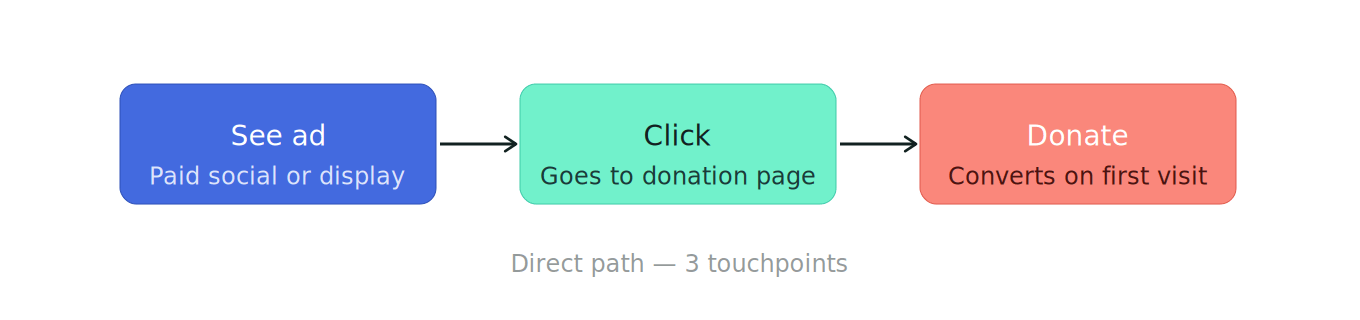 They look more like this: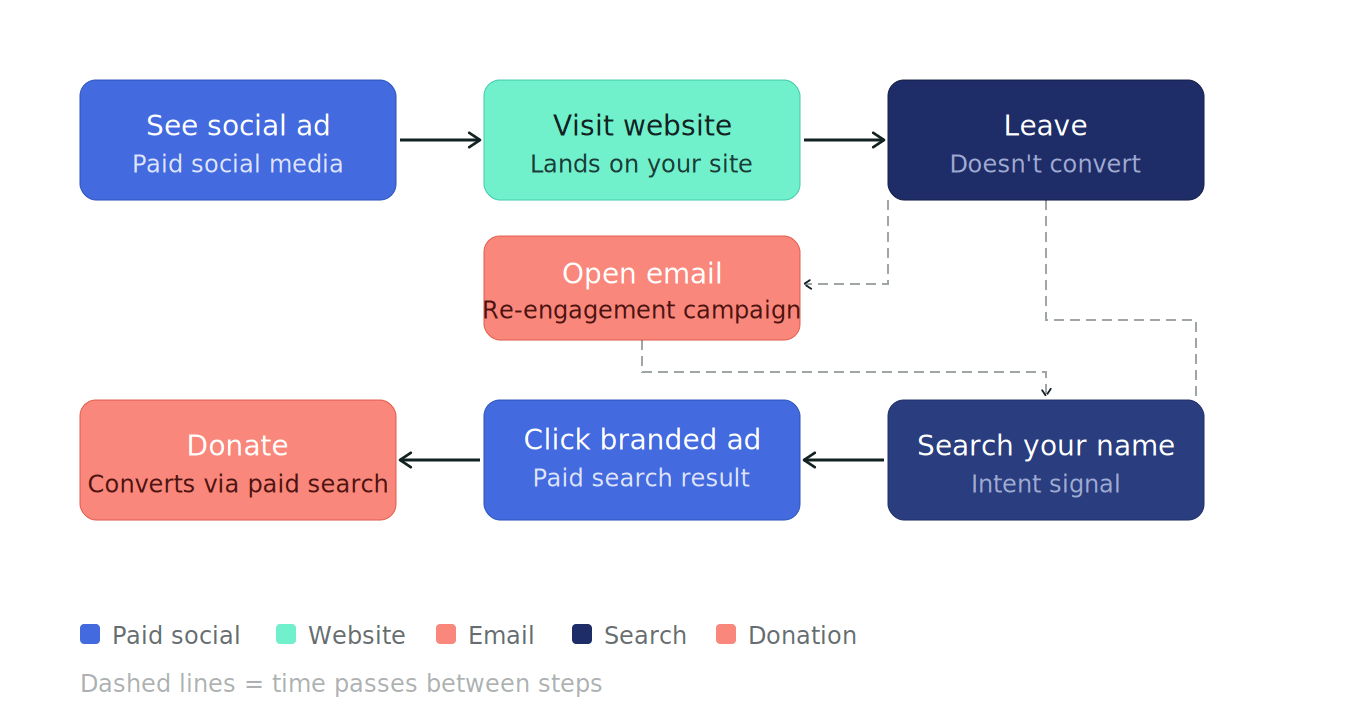
That’s why attribution matters.
Breaking Down Multi-Touch Models
Multi-touch attribution spreads credit across multiple interactions, giving you a more realistic view of what’s working.
Here are the most useful models for nonprofits.
- Linear Attribution: Every touchpoint gets equal credit. This is helpful when you want a broad view of how channels work together.
- Time-decay Attribution: More credit goes to interactions closer to the conversion. This is useful for longer fundraising cycles or event campaigns.
- Position-based Attribution: More weight goes to the first and last touch, with partial credit in the middle. This is good when you want to value both discovery and conversion.
For many nonprofit organizations, this is enough to move from guessing to informed decision-making.
4 Actionable Steps to Improve Attribution Today
You don’t need a massive tech stack to get started. You need consistency.
1. Use UTM parameters on everything that matters.
- Every paid ad
- Every email campaign
- Every social post you actually care about tracking
At minimum, standardize:
- utm_source
- utm_medium
- utm_campaign
This is what allows you to see where your traffic is actually coming from.
2. Align naming conventions across platforms.
If your Google Ads campaign is called “donation_search_q4” but your CRM logs it as “google / cpc,” you’re already losing clarity.
Consistency = visibility.
3. Set up conversion tracking that reflects real goals.
Track donations, volunteer signups, email subscriptions, event registrations, and resource downloads. Do not stop at pageviews or time on site and call it insight.
4. Connect your CRM to your marketing data.
This is the step most nonprofits skip, and it’s the most important.
If your donation platform or CRM isn’t connected to your ad platforms or analytics tools, you can’t see which campaigns are actually driving revenue.
When you close the loop, you can answer questions like:
- Which campaigns drive first-time donors?
- Which channels lead to repeat giving?
- Where should we invest more budget?
Build a Unified Media Ecosystem
Most nonprofit marketing falls apart because each channel behaves like its own little island.
Your paid search is doing one thing. Your social media team is doing another. Your email marketing sounds like it came from a different organization entirely. Meanwhile, your audience experiences it all as one brand.
A unified media ecosystem fixes that.
At the center is a cross-channel strategy that connects:
- Paid search
- Google Ad Grants
- Social media
- Facebook ads
- LinkedIn campaigns
- Email marketing
- Landing pages
- Website content
- Partnerships
- Organic digital marketing efforts
Each part should support the same goal and the same messaging.
Someone who clicks a search ad should land on a page that matches the ad’s promise. If they don’t convert, they might see follow-up paid ads on social. If they join your email list, your nurture sequence should sound like the same campaign, not a total reset.
That consistency builds trust. It also improves conversion rates.
A simple framework for this is PESO:
- Paid media brings in new audiences
- Earned media builds credibility
- Shared media drives engagement through social media
- Owned media deepens the relationship through your website and email marketing
When these pieces work together, your nonprofit marketing stops feeling random.
From Activity to Strategy: Your 30-Day Roadmap
Shifting from scattered activity to a real strategy doesn’t happen overnight, but you can make meaningful progress in 30 days if you focus on the right things.
Step 1: Audit Your Current “Noise”
Take an honest look at everything your team is doing right now. The goal here isn’t to judge, it’s to get clarity. Identify what’s actually driving engagement or conversions and what’s simply filling time. If something isn’t contributing to your goals, pause it. This creates immediate space to focus on what matters.
Step 2: Define Your North Star Metric
Instead of trying to improve everything at once, choose one primary outcome to focus on for the next quarter. That could be online donation revenue, volunteer sign-ups, or email list growth. This becomes your filter for decision-making. If a tactic doesn’t support that metric, it’s a distraction.
Step 3: Implement Tracking Infrastructure
You don’t need a perfect system, but you do need a functional one. Implement basic tracking infrastructure, such as UTM parameters, across campaigns, and ensure your CRM accurately captures conversion data. This is what allows you to connect effort to impact and finally understand what’s working.
Step 4: Analyze, Pivot, and Power Up
Review your performance regularly and look for patterns. Which audiences are engaging? Which messages are converting? Use that data to make informed decisions. Double down on what’s working, pivot away from what isn’t, and test new ideas with intention.
Stop Posting, Start Progressing
Activity does not equal impact. Your mission deserves more than scattered efforts and surface-level metrics. It deserves a unified, data-backed strategy that drives real results.
The good news? You don’t need to do everything. You just need to do the right things consistently. If you’re ready to move from noise to impact, it starts with a strategy. And if you want help building one, we’re here to help.
FAQs
How Do Donors Prefer to Hear From Nonprofits?
It depends on the donor. Some prefer email, others engage more on social media, and many respond to a mix of channels. The key is segmentation. Meet your audience where they are, and tailor your messaging accordingly.
How Can Paid Advertising Benefit Nonprofits?
Paid advertising allows you to reach the right people at the right time. It’s scalable, highly targeted, and measurable. When done correctly, it can significantly increase donations, awareness, and engagement.
Why Are Nonprofits Not Using Paid Ads?
There’s often a hesitation around spending money on marketing instead of programs. But without visibility, even the best programs struggle to grow. Strategic investment in media can amplify impact, not take away from it.
How Can Nonprofits Measure the Effectiveness of Their Paid Media Campaigns?
Start with clear conversion goals. Use UTM parameters to track campaigns, connect your data to your CRM, and monitor metrics like conversion rate, cost per conversion, and ROI. This gives you a full picture of what’s working.