
16x more conversions for a Smithsonian-affiliated history museum
- Google Grant
- Paid Social
- Paid Search
The challenge
Tampa Bay History Center had an active Google Ad Grant but wasn't using it to its potential — low utilization, minimal conversions, and no paid media strategy connecting search to the broader goal of driving museum attendance.
The results
Cordelia Labs built a multi-channel paid media program around the Grant, layering in Microsoft Ads and programmatic display to extend reach — scaling monthly conversions from 51 to 847 and pushing Grant budget utilization above 85% consistently.
-
16x
Conversion growth
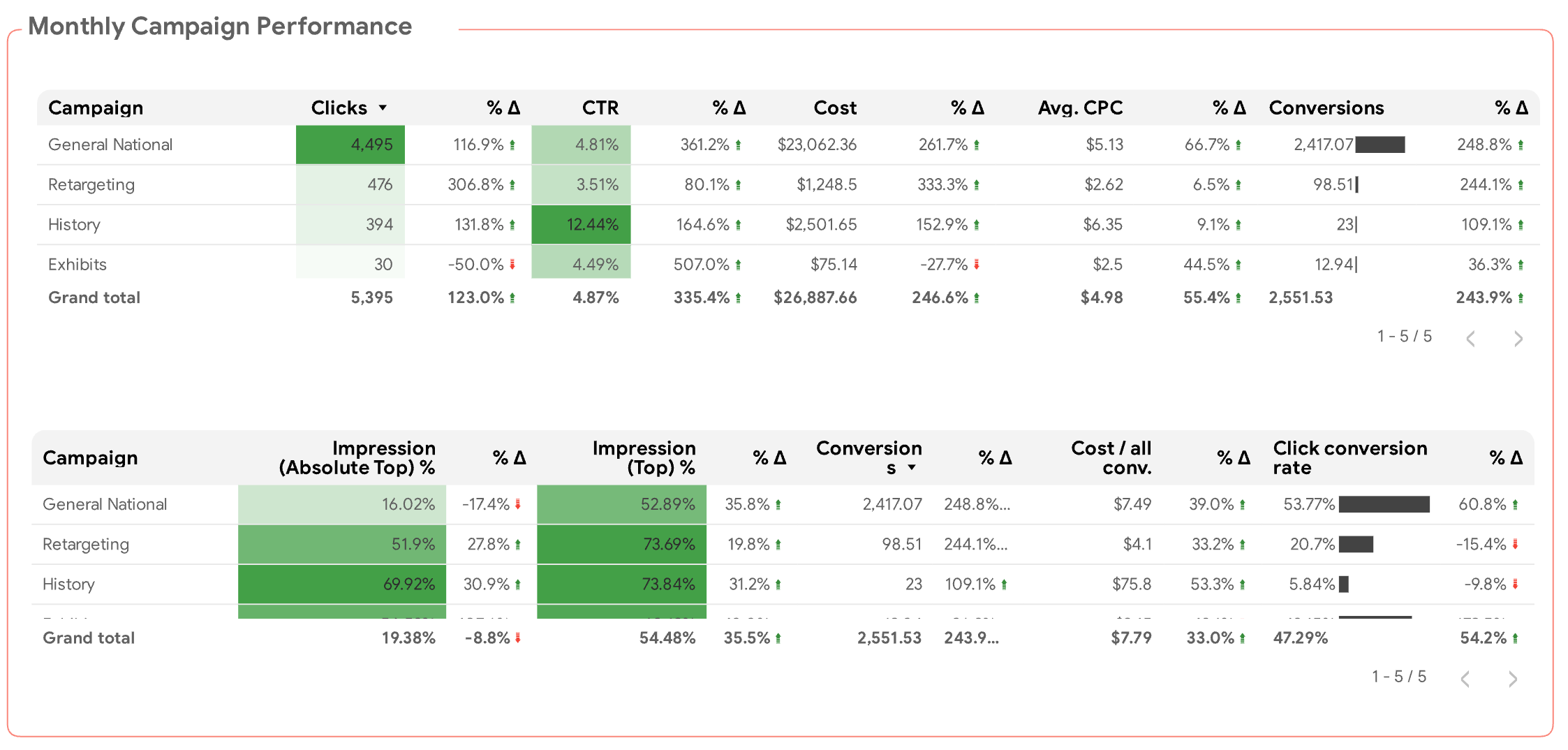
Monthly conversions grew from 51 in June 2025 to 847 in February 2026 as paid media campaigns aligned directly with ticket-driving goals.
-
2,036
Monthly Grant clicks (peak)
Google Ad Grant traffic scaled from 481 clicks in the first month to 2,036 qualified clicks at a sustained 6%+ CTR.
-
$0.37
Cost per click (Microsoft Ads)
Microsoft Ads delivered 100,000+ monthly impressions at $0.37–$0.42 CPC, extending reach efficiently beyond Google Search.
-
93%
Grant budget utilization (peak)
Grant spend climbed from underutilized to above $8,500/month — putting the full value of TBHC’s $10,000 monthly grant to work.
The challenge
Tampa Bay History Center had access to a Google Ad Grant worth $10,000 per month in free search advertising. In July 2025, the month Cordelia Labs took over, the account spent $1,659 — 16% of the available budget. CTR was running below Google's required 5% compliance threshold, putting the account at risk of suspension. Campaigns weren't structured around what the museum actually needed: people buying tickets, booking events, and planning visits.
The grant wasn't a resource problem. It was a strategy problem.
The approach
Cordelia rebuilt the account around search intent that maps to museum attendance. That meant restructuring campaigns to target people actively searching for things to do in Tampa, museum experiences, local history, and family outings — then aligning ad copy and landing pages to drive ticket purchases and event registrations rather than passive site visits. Conversion tracking was overhauled so every dollar of grant spend tied back to a measurable action.
As Google performance stabilized, Cordelia layered in Microsoft Ads to extend reach into a complementary search audience at very low cost, delivering 100,000+ monthly impressions at $0.37–$0.42 per click. Each channel reinforced the other: Google captured high-intent visitors already searching for the museum; Microsoft built visibility among people earlier in the trip-planning process.
The results
Monthly grant spend climbed from $1,659 in July 2025 to $9,460 by March 2026 — 94% utilization — while CTR simultaneously rose above the 5% compliance floor and held there. That combination is the hard part: most accounts can scale spend or maintain CTR, not both at once. Monthly conversions grew from 51 to 847, a 16x increase driven by stronger campaign structure, tighter audience targeting, and continuous keyword optimization.
For a museum whose mission depends on community engagement, the numbers translate directly: more qualified visitors reaching exhibit pages, event listings, and ticket purchase paths. Billy Somerville, Sr. Director of Marketing and Communications, put it clearly — the right paid media partner for a nonprofit has to understand the mission and the audience, not just the platforms.
For nonprofits, the right agency partner needs to understand the mission, the audience, and the relationship an organization has built with its supporters. Cordelia Labs has become a valued partner for the Tampa Bay History Center, developing paid media strategies that strengthen our broader advertising efforts, increase traffic to our digital channels, and help us reach future museum-goers.
About the client
Tampa Bay History Center
Tampa Bay History Center is a Smithsonian-affiliated museum in downtown Tampa dedicated to preserving and sharing the 12,000-year history of the Tampa Bay region. The museum serves residents, students, and visitors through exhibitions, educational programs, and community events — making local history accessible and relevant to all.